Showing posts with label monarda. Show all posts

Sunday, July 31, 2011

Local Tomatoes, Bread and Homemade Beebalm Tea

Summers in North Carolina bring both laments and blessings. This week, the main topic of conversation was the extreme heat (104 degrees on Friday). But the heat didn't stop the cherry tomatoes from continuing to produce, or keep the farmers from the market Saturday. With pleasure this evening, we realized our entire meal was made of locally produced food. 


The salad includes cherry tomatoes we grew, plus tomatoes, green beans, eggplant, cucumber and red onion from the farmer's market. The tomatoes, beans and onion were so full of flavor that we didn't need a salad dressing. The bread was made by a man who buys organic whole wheat from local farmers. He bakes the bread in a wood-fired oven in his dining room and even splits his own wood. He hauls his loaves of bread to market on a cart towed behind his bike. The bread not only has a low carbon footprint, but is delicious. (Some day I'll write a post on the Carrboro Farmer's Market. It's one of the treats of living in this community, having access to tasty local produce, all grown within 50 miles of Carrboro.)

I am proud of the iced tea, my first attempt ever at homemade tea. I've read many times that the Indians used to make tea from beebalm leaves, but never got around to making any until this year. Since the beebalm patch is outgrowing its bounds, I was able to combine harvesting with weeding. A brief Google search turned up a recipe that was ridiculously easy.
  • Strip leaves from monarda right before or right after bloom.
  • Lay leaves flat to dry for three days.
  • Crumble leaves.
Here is how the leaves looked after three days.


Since our summers are so humid, the leaves didn't dry completely, so I put them in the oven on low temperature for about 10 minutes. It was fun to crumble them. It's hard to describe the taste of the tea - it's fragrant with a mild, refreshing taste.


I'd love to hear about teas you've made from plants in your garden. Now that I know how easy it is, I'm inspired to make more herbal teas. 

Friday, June 24, 2011

Of Bees and Men

“People need insects to survive, but insects do not need us.”  ~ E.O. Wilson


After many hours spent on a computer this week, it was a relief to have an assignment to watch bees.  I learned about the Great Sunflower Project from Donna at Gardens Eye View and immediately decided to participate. As a gardener, you probably already know about Colony Collapse Disorder, the devastating syndrome in which large numbers of bees disappear from their hives and never return. 

Many beekeepers believe bees are being poisoned by neonicatinoids, widely used insecticides broadcast over crops. Government scientists see the culprit as varroa mites. Others have proposed that electromagnetic radiation from cell phones could be the cause, or that honeybees have been weakened by being pressed into commercial service and trucked around the country to pollinate crops. But no one disagrees that bees are dying in large numbers.

Even before I learned of the dying bees, I worked to make my garden attractive to pollinators, with native plants in bloom from spring to fall. To fulfill my assignment as Citizen Scientist, all I had to do was choose a flower, watch it for 15 minutes, count the number of bees, and submit the data online.  I chose monarda because a large patch is peaking now in a dazzling display of raspberry red flowers.


The project's leaders are hoping to learn more about urban populations of bees. I expected to see swarms of bees - monarda is knows as bee balm for a reason. But for 10 minutes, all I saw was one bumblebee, singlemindedly working the patch. The bee clambered in, on and under each of the many tubular flowers that make a flower head. 

                                                                            
Below, you can see the bee pulling down the lips of one of the tubular flowers to get to the nectar.


I enjoyed my observations of the bee, but I began to worry - why had only one bumblebee appeared? I'm an organic gardener, but many of my neighbors are not. Were bees being poisoned in my neighborhood, too? 

I looked around and spotted a second bumblebee on the flat pink blooms of a nearby Japanese spirea. I made an executive decision to count it, though I'm pretty sure a real scientist would have considered it outside the scope of the study. But it was a bee and it was there, so it counts. At the 14-minute mark, two honeybees appeared, one on the adjacent purple coneflower and one on the beebalm. Just under the wire, the honeybees catapulted my garden into the "great" category for bee visitations. 

One day later, I took the photograph below. The flower has been well loved. The tubular flowers that once stood erect have been pulled down, exposing the center of the flower head. 


Even if my garden is great for bees, the problem of the vanishing bees is a problem of the commons. No matter how many swathes of native plants we organic gardeners plant, bees won't survive if our neighbors have sterile yards drenched in insecticides. The biologist E.O. Wilson in "The Creation: An Appeal to Save Life on Earth" imagines the "cataclysm" of a world without insects. 

-"A majority of the flowering plants, upon being deprived of their pollinators, cease to reproduce.

-"Most herbaceous plant species among them spiral down to extinction. Insect-pollinated shrubs and tress hang on for a few more years, in rare cases up to centuries.

-"The great majority of birds and other land vertebrates, now denied the specialized foliage, fruits, and insect prey on which they feed, follow the plants into oblivion.

-"The soil remains largely unturned, accelerating plant decline, because insects, not earthworms as generally supposed, are the principal turners and renewers of the soil.

-"Populations of fungi and bacteria explode and remain at a peak over a few years while metabolizing the dead plant and animal material that piles up.

-"Wind-pollinated grasses and a handful of fern and conifer species spread over much of the deforested terrain, then decline to some extent as the soil deteriorates. 

-"The human species survives, able to fall back on wind-pollinated grains and marine fishing. But amid widespread starvation during the first several decades, human populations plunge to a small fraction of their former level. The wars for control of the dwindling resources, the suffering, and the tumultuous decline to dark-age barbarism would be unprecedented in human history.

-"Clinging to survival in a devastated world, and trapped in an ecological dark age, the survivors would offer prayers for the return of weeds and bugs."

Wilson concludes, "The bottom line of my scenario is this: be careful with pesticides. Do not give thought to diminishing the insect world.” 


Saturday, June 18, 2011

June: What's in Bloom

The garden surprised me this morning with this beautiful bloom, the first of the season on Rose of Sharon 'Helene.'


Often I am disappointed that I can't get the camera to record the beauty of what I see. But sometimes the camera makes beauty out of something ordinary. I almost missed the hidden bloom on the Rose of Sharon. 


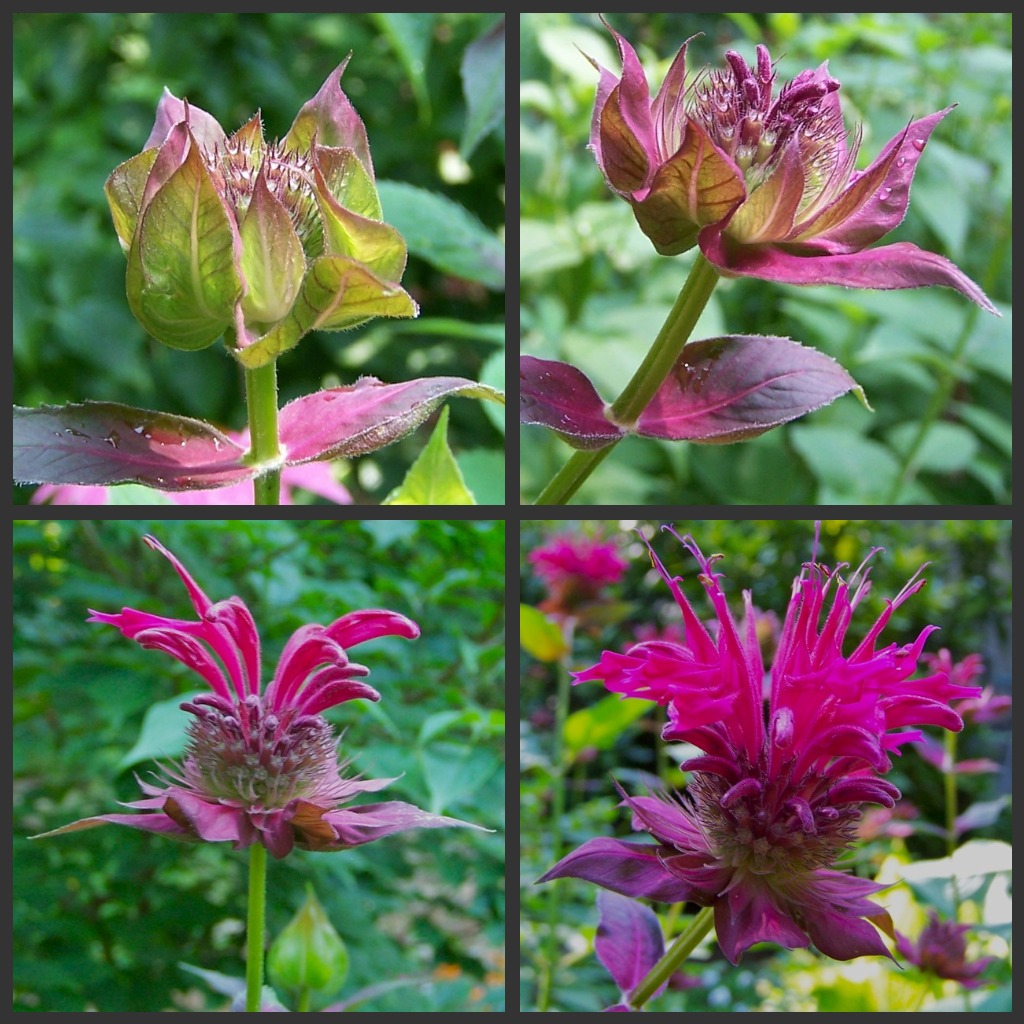
I've been watching the beebalm flowers emerge.  Before I picked up the camera and began documenting my garden, I rarely paid attention to the beauty of emerging blooms. 


Beebalm (Monarda didyma 'Raspberry Wine') has commandeered a sizable patch in my too-small sunny perennials bed. Actually, it's only a part-sun bed, but sunny is a relative term in the woodland garden. The bees and butterflies love it, so I don't have the heart to groom the monarda patch the way I probably should. 

It grows with coneflower in my garden. Hmm ... these were sold to me as dwarf coneflowers a few years ago. Maybe one of the plants is still a dwarf.


I've also been watching the coneflowers (Echinacea purpurea) emerge. They have a different personality in each stage. Coneflowers, too, attract butterflies. 


Blue flowers look cool in the heat. Salvia guaranitica grows in part sun and is visited regularly by the ruby-throated hummingbird. 


Dwarf plumbago (Ceratostigma plumbaginoides)
is attractive on the edge of the bed. I think it would flower better in full sun, but I'm happy with anything that flowers. 


A frilled pale yellow lily (name tag long lost) has been blooming prolifically under Salvia guaranitica. It has a wonderful fragrance, too. 


Speaking of fragrance, Gardenia jasminoides 'Radicans' is now in full bloom. It's a low-growing variety that blooms after Kleim's Hardy has finished flowering. It has wonderful, intricate blossoms. 


Abelia is also in full bloom. Its blooms are dainty and waft a sweet scent over the stone walkway. I like its arching branches. It nicely screens the neighbor's house, too. 


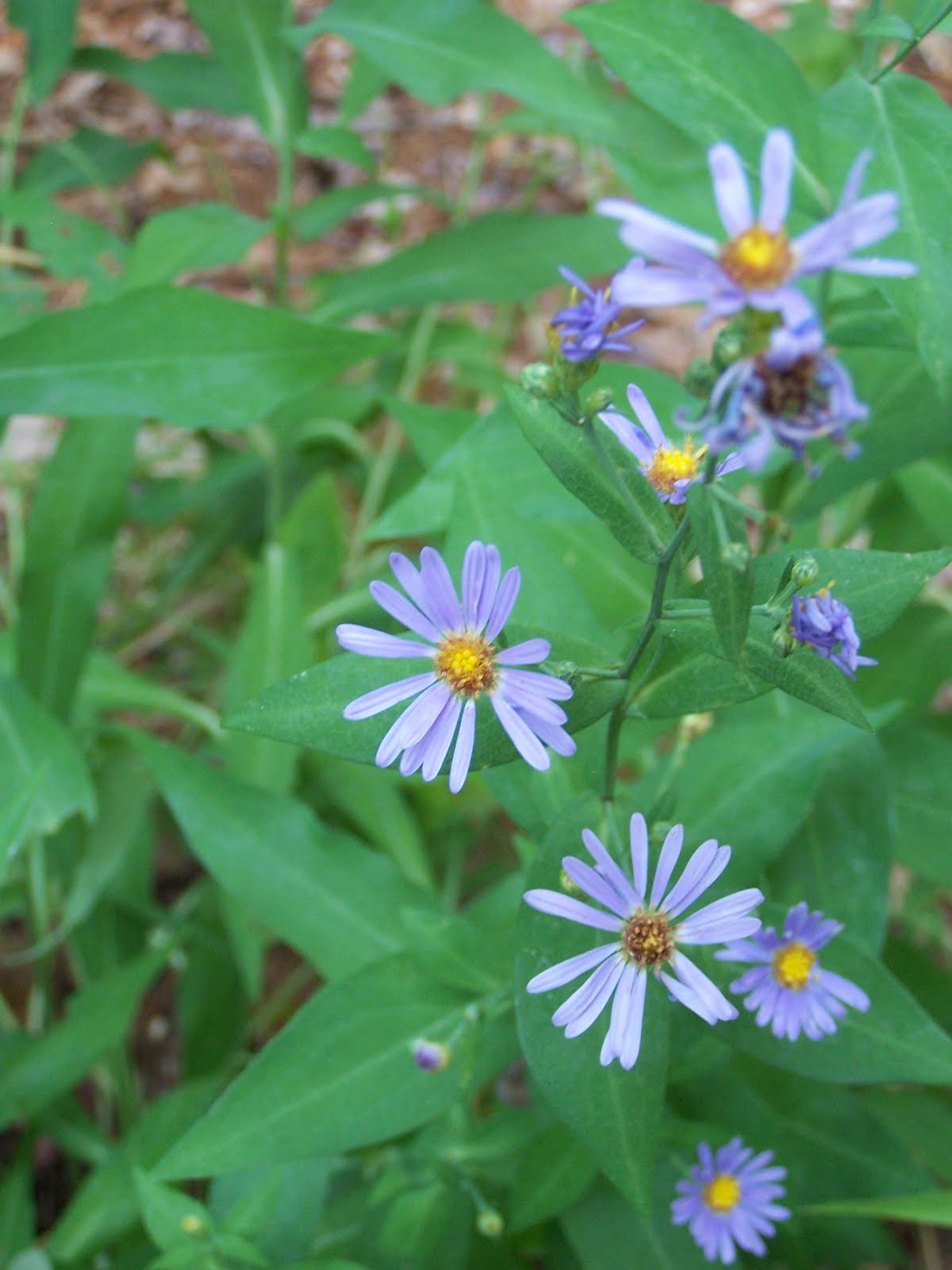
This aster is blooming now. I lost its name tag, too. I didn't suspect I would become a garden blogger.


I adore the cheery yellow blooms of rudbeckias (Rudbeckia hirta) and the way they self-seed. They don't bloom much in part sun and tend to flop over. Darn. The goldfinches don't help when they try to land on the stems. (Imagine being light enough to cling to a flower stem.)


Virginia mountain mint (Pycnanthemum virginianium) is a native plant with miniature blooms that attract pollinators, including butterflies. 


Last is one disappointment, Coreopsis verticillata. I planted three plants five or six years ago. They bloomed well the first few years and spread to form a mass. As soon as they took over a good portion of the "sunny" perennial bed, they decided to be stingy with blossoms. I threatened them last week after reading Jean's post, Bloom or Get Out.  I see what look like tiny yellow buds on them, but they've been there for weeks. I'm tempted to pull them out now, but it's really stupid to put in new plants in midsummer in North Carolina. I should know - I do it almost every year. 


When I look, I always find more in bloom than I think in the woodland garden.