Wednesday, July 13, 2011

Blue Ridge Mountains

We spent a weekend in the Blue Ridge Mountains, going for hikes and enjoying the beautiful surroundings and cooler temperatures (70s!). Now I'm stunned by the 100-degree heat, having lost my heat tolerance while away. I am indulging fantasies of moving there. Here is the view from the front porch of our B&B in Valle Crucis, NC.


The first day we hiked on Grandfather Mountain, starting at Mile 302.8 of the Blue Ridge Parkway. I was enchanted with the lush forest from the start of the walk.  


Ten-to-fifteen foot high rhododendrons, in full bloom, bordered much of the path until we got to higher elevations. Unfortunately, the rhodies with their pinkish-white blooms are difficult to photograph with a point-and-shoot camera. But the effect was magical.


I later learned that the rhododendrons are Rhododendron maximum, a variety that alternates a growth year with a bloom year. I am grateful that we got to experience them in bloom - an unexpected treat.


Here is a tree with a will to live. 


The trail was narrow but well-maintained. It's part of the Tanawha Trail. The hike we did was recommended by the Appalachian Treks blog, a random Internet find with great information about (and lovely photos of) different hikes. 


We come to the first of two overlooks. Can you see why the mountains are known as the Blue Ridge? Although the view is stunning, there is nothing stark about it, as the mountains are clothed in forests. Even the high ledges, known as heath balds, are green with azaleas and blueberry bushes growing in crevices. 


The light breaking through the clouds creates lovely patchwork effects. 


A view toward the Linn Cove viaduct.


Coming down from the ridge, we soon came to the most magical meadow I have ever seen. It was an opening on a sloping mountainside filled with wild phlox, bee balm and a few yellow composites. 


Michaux's saxifrage grows in a crevice.


On our way back, clouds were blowing across the rocks high on the mountain.


A hiker sits and looks down into a valley hidden by clouds. 


Valle Crucis has a lovely community park where we walked in the evenings. It has views of mountains in every direction. Here, we look across farmland to the high hills. 


The Watauga River runs through Valle Crucis. We waded into the cool waters. The river used to be known for its pristine water. But a controversial shopping mall built at the headwaters of the river resulted in silt overflows into the river for 20 miles downstream. The water still looks clear by the standards of the rivers and creeks I frequent. 


This is the largest sycamore tree I've ever seen. 


Another view from upper Valle Crucis. 


View from the Beacon Heights overlook. We sat here for awhile to absorb it. Mountaintops make me feel small, in a good way. I get the sense of being part of something much greater. 


This is the glorious, loud, rushing falls at Crab Orchard Creek. I sat here and tried to let the sound of the water carry me away ... 


I'm already wondering when I can get back to the Blue Ridge Mountains.

Monday, July 4, 2011

John Muir and Freedom

Reading John Muir has filled me with enchanted visions of mountains and wildness. So today I drove 12 miles north to the nearest high point, the 867-foot Occoneechee Mountain, and walked its trails. Tall trees block most of the sky in our area, so it was refreshing to see a vista after scrabbling up the white, flaky cliffs on the northeast side of the "mountain."


I thought of Muir and his joy in the wilderness, of living on bread and tea and sleeping on beds of pine needles and cedar boughs while exploring the Yosemite. His idea of freedom was radically different from ours - we tend to think of freedom as having enough money to purchase whatever we happen to want. Muir's freedom was that of time and experience, not comfort.


He pitied the constraints his friends placed on themselves. When his friend Professor Butler came to the Yosemite Valley, Muir tried to convince him to camp in the High Sierra. But the professor only had two days to spend in the region and Muir bade him goodbye. 

"I'm glad I'm not great enough to be missed in the busy world," Muir writes. " ... I scrambled home through the Indian Canyon gate, rejoicing, pitying the poor Professor and General, bound by clocks, almanacs, orders, duties, etc., and compelled to dwell with lowland care and dust and din, where Nature is covered and her voice smothered, while the poor, insignificant wanderer enjoys the freedom and glory of God's wilderness."

Friday, July 1, 2011

A Morning With a Camera

This morning I dallied on the front porch with the camera. I didn't have any freelance work. I did have plans to work on my thesis. But since the topic is, at its broadest, on the evolving religious understanding of God in nature, I decided that watching the bluebirds build their third nest of the season was in some way connected. I have a gift for rationalization ...

The mother bluebird has been bringing fresh pine straw to the old nest for the past two days. Bluebirds  appear to reuse the old nest, freshening it on top. Bluebirds are good housekeepers - when the last brood was in the box, several times I saw the parents carry out pellets of bird droppings. 


It's been a little over two weeks since the bluebirds fledged. I've seen them following their parents from tree limb to tree limb. One kept investigating its mother's work.


The juveniles often seem to be looking for handouts. This little scene made my day.


Around 10 a.m. I decided I must get some work done on the thesis. I had to go to the Duke Divinity School Library. The nearest parking lot that I could find was at Sarah P. Duke Gardens, so of course, I had to walk through the gardens on the way to the library. I'd been wanting to visit again ever since reading this post at Carolyn's Shade Gardens. 

The first planting that caught my eye on the walk into the gardens was this striking combination of pineapple lilies with chartreuse foliage and cheery yellow flowers. 


The native plants section just happened to be on they way to the library. I have never seen a bottlebrush buckeye in bloom before. This is a young plant - further up the path was a huge specimen that must have been 12 feet tall and wide. 


Amid the greens of the summer shade garden, cardinal flower (Lobelia cardinalis) was jaw-droppingly beautiful. 


The hummingbird liked it, too. 


I came to a pond with charming stepping stones.


I have never seen so many dragonflies. 


Summer woodland gardens in North Carolina tend to be subdued. The real show of wildflowers is in spring. Yet Duke has some unusual specimens in bloom, such as a hybrid native azalea. 


Ever since I was a child, I have always liked secluded seating places outdoors. 


 I like the use of Christmas ferns along this path.


Another shady grotto. I think if I were a Duke student, I would spend all my time studying in Duke Gardens.


Then I came upon my favorite tree of all, the big-leaf magnolia. The leaves are ENORMOUS and look tropical. They are from 12 to 32 inches long. I'd guess this specimen's leaves are about two feet long.


Unlike the Southern magnolia, the big leaf is deciduous. 


 If I were a child, I would have stopped and played under this magnolia. If it rained, I wouldn't get wet. 


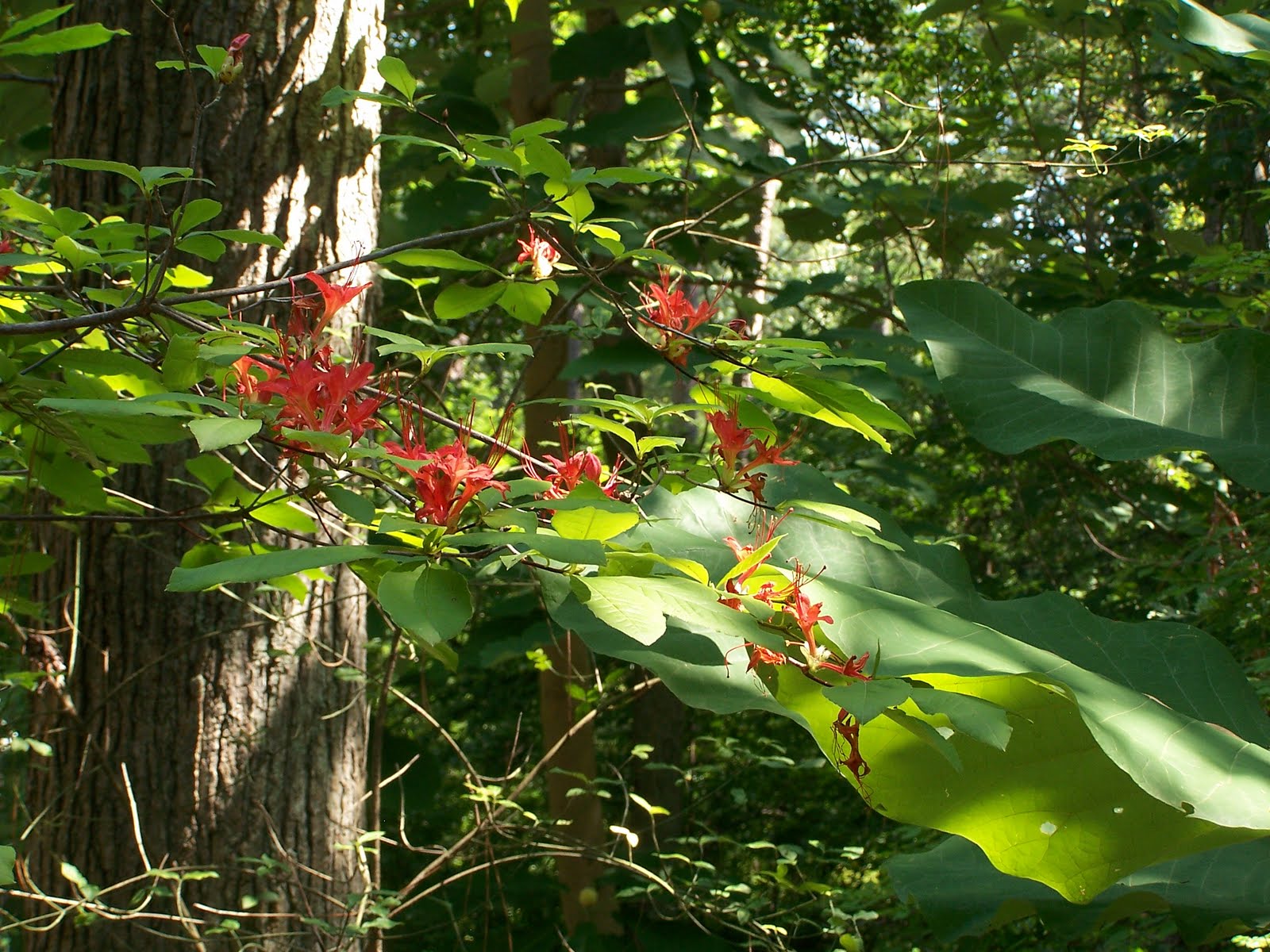
Every year in July I decide I want a plum leaf azalea. Here one glows red next to another big leaf magnolia.


I did finally get to the library, and after some minor problems, such as finding the journal I was interested in was written in German, I emerged into the midday sunshine. I walked back through the more formal part of Duke Gardens. 


The sun was glaring in the perennial beds and the vibrant colors were stunning. I never would have thought of combining orange daylilies with purple phlox, but it was gorgeous. The photo doesn't do it justice. 


If we move to a property that gets more sun, this is what I want my cottage garden to look like. 


Curving formal paths lined mainly with annuals transect this part of the garden. 


Rudbeckia, purple phlox, yellow daylilies and red roses make a strong statement in the noonday sun.


I did eventually have to turn the camera off. But it was a fun morning of "research."