Showing posts with label native plants. Show all posts

Tuesday, June 26, 2012

Saying Goodbye to a Garden


It's been a week of lasts. Last visit to the Carrboro Farmer's Market on a Saturday morning. Last watering of plants in the garden. Last sitting on a bench in the backyard watching birds. Last walks on familiar routes, where I saw deer and red-shouldered hawks. One block from my house, I heard a rustling in the trees along the road. I stopped, waited and a doe emerged, then two tiny fawns, covered in white spots. The doe stood still, looking right at me. I looked back. One fawn and then the other ran to their mother and began nursing.

Later, behind the deer fence, I dug up favorite plants. I felt a slight sense of guilt, even though these are my plants. But the letter of the contract on the house sale says that all plants in the ground are considered part of the property. Shh... Who's to know three or four dozen plants are moving with me? In fact, they're already resting under a pine tree at the new house, where the seller kindly offered to water them.


I took my favorites. Young shrubs that have not yet bloomed - two native azaleas, one pinxterbloom and one 'Clyo Red.' A Clethra alnifolia 'Hummingbird,' an Ilex sentinel holly, my only surviving blueberry bush. Two Christmas ferns, a few heucheras of purple and green variegated and limegreen foliage, hellebores, a spreading tiarella, three canna lilies ('Bengal Tiger') and a maidenhair fern. Japanese roof lilies, green 'n gold, and monarda, all of which will spread to become sizable patches. There must have been more - I dug for hours and filled two cars with plants, but I am not thinking clearly after days of packing.

More than 30 plants fit in a compact Prius.


I wish I could move the bluebirds with me. I believe the eggs hatched the other day. The male bluebird has been hovering around the box, proudly perching on the box top with fat green caterpillars and later a yellow moth. The bluebird then would fly to a favorite dead branch, eat his meal and return to the box, sometimes disappearing inside. This morning the male kept anxiously peering at the hole after the female went inside with an insect.


Then he disappeared inside the box. I'll miss the bluebirds. I hope bluebirds come live at our house in Raleigh. 


Wednesday, September 28, 2011

Wildflower Wednesday

It's been a long time since I posted photos of flowers. Perhaps it's because it was too hot (mid- to upper-90s) most of the summer and the plants went into survival mode. But now a few prolific fall wildflowers have exploded with color. 

Below is Eastern aromatic aster (Symphyotrichum oblongifolium). It takes sun or part shade, and even though it flops in my garden because of lack of sun, it blooms profusely. 


I adore the color of New England aster (Symphyotrichum novae-angliae). 


Here is oxeye or false sunflower (Heliopsis helianthoides), blooming happily. It is flopping (like most of my sun-loving plants), but if you have full sun it will grow 3- to 6-feet tall. I think it would look beautiful planted with the two asters above. 


I believe the plant below is Rudbeckia hirta var. angustifolia (see narrow leaves at top left of photo), but please correct me if I'm wrong. It was a freebie from my time volunteering at the N.C. Botanical Garden. 

All of the wildflowers featured here attract butterflies. Notice the nice flat landing pads and easy-access pollen. 


Native trees and shrubs are fruiting. Birds have been feasting on dogwood berries.


Below is Ilex verticillata 'Red Sprite.' So far, the birds don't seem interested in it, which allows me to enjoy the beauty of the berries. It's growing in part sun and average soil in my garden, though I have read it prefers full sun and wet soil. 


Beautyberry's (Callicarpa americana) purple berries are stunning.


I'm happy to participate in Wildflower Wednesday hosted by Clay and Limestone

Friday, July 15, 2011

Deer and Fawns

Last night I dreamed that a herd of starving deer jumped over the deer fence and devoured nearly all the plants in the garden.  I was relieved when I looked out the window this morning and saw that the redbud tree was still there, innocently spreading limbs displaying heart-shaped leaves at deer's eye level. I used to regularly have nightmares about hungry deer until we finally broke down two years ago and had a deer fence installed around the back garden. Deer are rampant in the neighborhood - as I write this, I hear a tell-tale crunching in the leaves outside the dining room window as two does pass through the yard. 

But like most gardeners, I have my contradictions. I enjoy having wildlife and native plants in my backyard, but not the deer that eat the native plants. And every summer in July, I contradict all my railings against deer and once again find that fawns are just too darn cute. Today my husband called me down from the office when he saw two fawns and a doe outside the kitchen window. 

I stayed behind the glass door and took a few photos. Then I got bolder and slowly opened the door. The doe and fawns moved a few feet further away, but then stopped and looked back at me with their big liquid eyes. I moved very slowly down the steps, stopping often, so the deer wouldn't startle. This would not normally be necessary. The does in our neighborhood are so tame that  I can run toward them full speed, shouting and with arms waving, and get no response but a calm stare until I'm practically close enough to tackle them. But I figured the doe would startle more easily now that she has fawns. 


After a few minutes, the fawn in the foreground in the photo above became curious about the human who was standing frozen in the leaves with a black box held to her face. She started moving toward me. It warmed my heart to have this adorable fawn show such trust and curiosity in me. I have been reading about St. Francis and his conviction that all creatures are our brothers and sisters. As I watched the fawn slowly walk toward me, I felt a sense of kinship.

Still, I don't regret the deer fence. Deer are much more of a joy to watch in the neighbor's yard!

Friday, July 1, 2011

A Morning With a Camera

This morning I dallied on the front porch with the camera. I didn't have any freelance work. I did have plans to work on my thesis. But since the topic is, at its broadest, on the evolving religious understanding of God in nature, I decided that watching the bluebirds build their third nest of the season was in some way connected. I have a gift for rationalization ...

The mother bluebird has been bringing fresh pine straw to the old nest for the past two days. Bluebirds  appear to reuse the old nest, freshening it on top. Bluebirds are good housekeepers - when the last brood was in the box, several times I saw the parents carry out pellets of bird droppings. 


It's been a little over two weeks since the bluebirds fledged. I've seen them following their parents from tree limb to tree limb. One kept investigating its mother's work.


The juveniles often seem to be looking for handouts. This little scene made my day.


Around 10 a.m. I decided I must get some work done on the thesis. I had to go to the Duke Divinity School Library. The nearest parking lot that I could find was at Sarah P. Duke Gardens, so of course, I had to walk through the gardens on the way to the library. I'd been wanting to visit again ever since reading this post at Carolyn's Shade Gardens. 

The first planting that caught my eye on the walk into the gardens was this striking combination of pineapple lilies with chartreuse foliage and cheery yellow flowers. 


The native plants section just happened to be on they way to the library. I have never seen a bottlebrush buckeye in bloom before. This is a young plant - further up the path was a huge specimen that must have been 12 feet tall and wide. 


Amid the greens of the summer shade garden, cardinal flower (Lobelia cardinalis) was jaw-droppingly beautiful. 


The hummingbird liked it, too. 


I came to a pond with charming stepping stones.


I have never seen so many dragonflies. 


Summer woodland gardens in North Carolina tend to be subdued. The real show of wildflowers is in spring. Yet Duke has some unusual specimens in bloom, such as a hybrid native azalea. 


Ever since I was a child, I have always liked secluded seating places outdoors. 


 I like the use of Christmas ferns along this path.


Another shady grotto. I think if I were a Duke student, I would spend all my time studying in Duke Gardens.


Then I came upon my favorite tree of all, the big-leaf magnolia. The leaves are ENORMOUS and look tropical. They are from 12 to 32 inches long. I'd guess this specimen's leaves are about two feet long.


Unlike the Southern magnolia, the big leaf is deciduous. 


 If I were a child, I would have stopped and played under this magnolia. If it rained, I wouldn't get wet. 


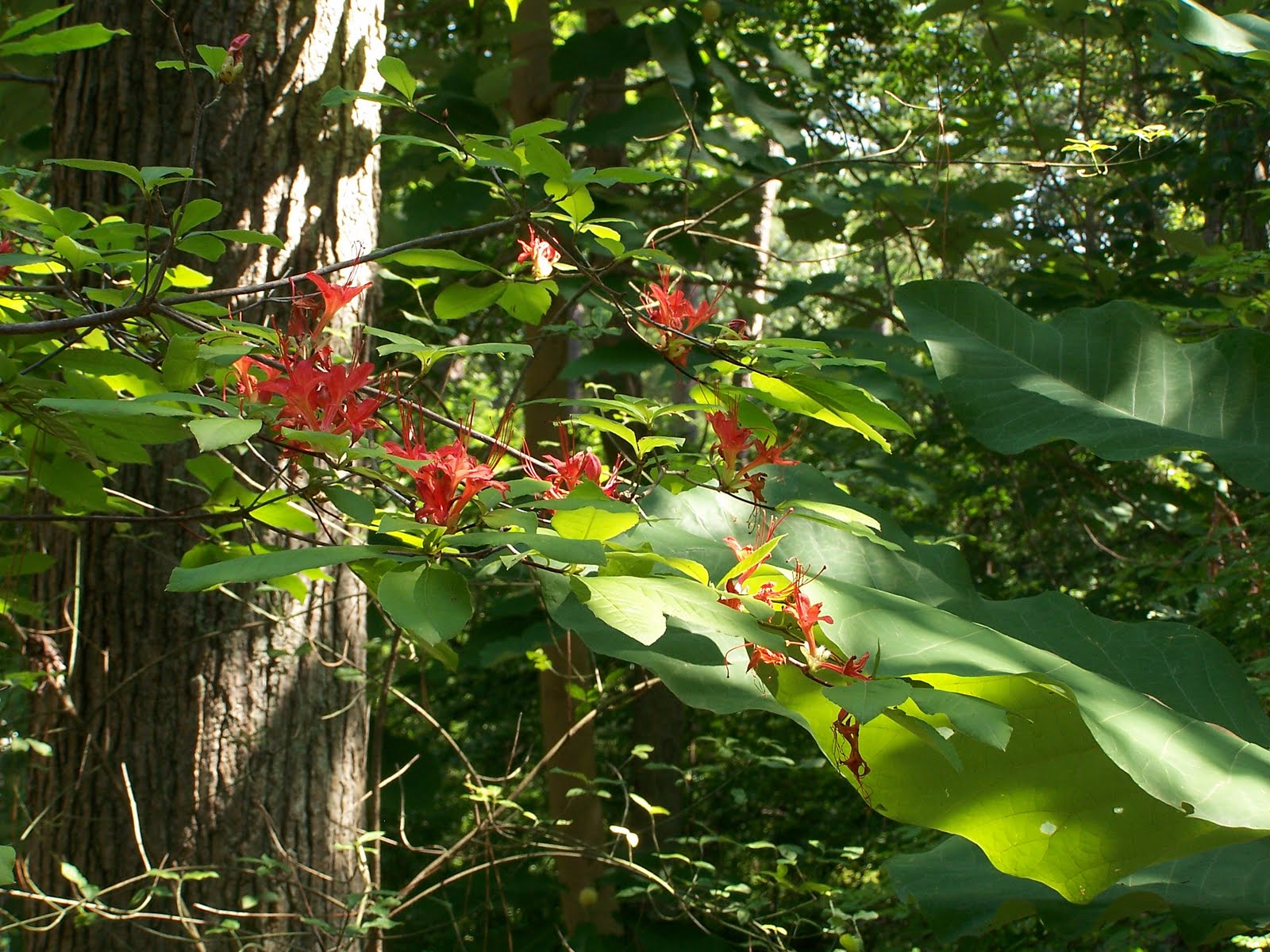
Every year in July I decide I want a plum leaf azalea. Here one glows red next to another big leaf magnolia.


I did finally get to the library, and after some minor problems, such as finding the journal I was interested in was written in German, I emerged into the midday sunshine. I walked back through the more formal part of Duke Gardens. 


The sun was glaring in the perennial beds and the vibrant colors were stunning. I never would have thought of combining orange daylilies with purple phlox, but it was gorgeous. The photo doesn't do it justice. 


If we move to a property that gets more sun, this is what I want my cottage garden to look like. 


Curving formal paths lined mainly with annuals transect this part of the garden. 


Rudbeckia, purple phlox, yellow daylilies and red roses make a strong statement in the noonday sun.


I did eventually have to turn the camera off. But it was a fun morning of "research." 


Saturday, April 30, 2011

Plants Attract Insects - Thank God

View from a St. Petersburg balcony.
Wouldn't a few potted plants be nice?
Balconies should be mini-gardens. I thought this was obvious. When I stepped out on the balcony at my parents' new condo in Florida, after admiring the view, I said, "It would be nice to have some plants out here." I already was envisioning an enjoyable trip to the nursery. What interesting subtropical plants would I find? Perhaps a saw palmetto would be nice. And some flowering Florida natives.

So I was unprepared when my Dad said, "Plants are discouraged here." 

What?! Why would anyone discourage having plants?

"Plants attract insects."

This remark stunned me to silence. 

I thought, "So? Why is that bad?"

At home, I see myself as a steward of a woodland garden that is friendly to insects and wildlife. (With an exclusion policy for deer.) Insects are a vital part of the food chain and eaten in large numbers by birds. And birds thrive in our garden. Last summer I counted 27 species that are regular visitors to the garden.

But how do I begin to explain my deep belief in living in harmony with all living creatures? Underlying my Dad's comment is the dominant view in our culture - insects are dirty and repulsive and to be excluded from our properties. So much so that we as a culture have been willing to poison our soil and water to eradicate insects that we find to be a nuisance. At least my Dad's prevention program is more peaceable - just exclude plants.

Oh, but when will we learn to love the web of life of which we all depend? 

Monday, August 2, 2010

Rhythms of Life

As a natural gardener, I strive for low maintenance. In the last few weeks, I have neglected both my garden and this blog after my husband had a heart attack. I even stopped refilling the bird feeder and bird bath for a couple of weeks. Nothing seemed to matter except caring for him.

Fortunately, the small half-sun vegetable garden was well-enough established by mid-June to survive neglect. Sungold and Sweet Million cherry tomatoes ripen by the dozens. And today I harvested a bowlful of Roma tomatoes, which will turn into sauce tomorrow.

Slowly, my interest in the garden has returned. It’s calming to watch a catbird splash joyfully in the birdbath. The cardinals and finches chase each other off the bird feeder. The ruby-throated hummingbird darts from salvias to annuals in pots, always in a hurry. The swallowtail butterflies flock to the Joe Pye weed. Today I saw six at one time on the small patch along the street. The rhythms of life continue, and when I slow down and watch, I see all’s right in the world.

Thursday, May 27, 2010

Of Butterflies and Weeds

The bright orange butterfly weed (Asclepias tuberosa) is one of the most beautiful plants flowering in my garden. As I backed out of the driveway yesterday, I spotted an orange butterfly, perfectly mimicking the orange of the flowers, sipping nectar. It flew off when I got out of the pickup in an attempt to identify it (monarch and viceroy butterflies are the two most likely candidates). Later, I saw a spicebush swallowtail feeding on the butterfly weed.
It pleases me to think that the many types of native perennials and shrubs I've planted (including spicebush) are providing food for caterpillars and nectar for butterflies. Monarch butterflies, for example, breed exclusively on milkweeds, of which butterfly weed is one.

Butterfly weed has another appealing attribute - it likes poor soil with no mulch, fertilizer, or need for supplemental water.  I planted mine three years ago, never watered it after the first year, and it blooms beautifully.

Friday, May 25, 2007

Climate Change in Chapel Hill

Much media attention has been paid in the last year to climate change and some of the more dramatic possible global consequences--sea level rise, drought, and disrupted water supplies, with poor nations bearing much of the burden. But, as a Chapel Hill gardener and frequenter of nature trails, I began to wonder what may happen in my own backyard.

The last 100 years have seen a warming and drying out in piedmont and coastal North Carolina. Temperatures rose significantly in the piedmont and coastal regions, with an increase of 3 degrees F in coastal Carolina between 1911 and 2002, according to a 2006 report by the State Climate Office of North Carolina. Although maximum summer temperatures did not increase significantly in the state in the last century, minimum temperatures rose, particularly in urban areas. As for rainfall, the greatest decrease occurred in Chapel Hill, which saw a decline of 4.1 inches between 1893 and 2002.

Although the International Panel on Climate Change has little to say about global warming’s likely consequences in the Southeastern United States, climate scientists do predict that an increase in temperatures will be accompanied by more frequent storms, more heavy rainfalls, and more frequent droughts.

Flora at the southern end of their distribution range, such as those found in the Appalachian Mountains, will be particularly affected by warming, according to a study by the National Biological Service. Spruces, firs and the rare endemic herbaceous plant, Geum radiatum, are highly vulnerable, says Johnny Randall, assistant director for conservation at the North Carolina Botanical Garden.

Closer to home, Randall says he worries most about Catawba rhododendrons growing on north-facing slopes of Morgan Creek. These rhodies are not particularly well adapted to warmer temperatures and unpredictable rainfall. “I think we’ll see them drop out relatively quickly,” he says.

If plants that like cool conditions may be losers, vines may well be winners in a warming climate. This includes the backyard scourge (and native) poison ivy, Toxicodendron radicans, as well as exotics like Japanese honeysuckle, Lonicera japonica. A study by Duke University found that poison ivy grew 2 ½ times faster with increased carbon dioxide.

A changing climate also favors weedy exotics such as Microstegium vimineum, says Randall. Weeds tend to take over disturbed sites because they are highly adaptable and have a lot of genetic diversity, traits that may give them even more of an edge when some native plants begin to struggle.

Some early shifts in vegetation are already detectable in the Piedmont, as wax myrtle (Myrica cerifera) and Baccharis halimifolia have begun moving inland from the coast, Randall says. It is unclear, however, whether this is related to global warming or to land disturbance created by development, he says.

What’s a gardener to do in these uncertain times? I began to wonder if my neighbor who created a garden entirely of tropicals had the right idea. But Randall helped abolish these heretical thoughts. “Planting native plants is more important than it ever has been if we want to maintain some biodiversity,” Randall says. Biodiversity is an important component of ecosystems’ resilience to change. Another reason to continue using Southeastern native plants in our gardens is that most of them are already are adapted to extremes of weather—heat, periods of drought, and heavy rainfalls.

So, I’m planting a variety of natives, most of them somewhat drought tolerant. I study the heat zone maps and avoid buying plants that are already at the southern end of their comfort zone. I installed a rain barrel to catch runoff from heavy rains and keep my new plants alive during droughts. And, most important, I’m doing what I can to reduce my carbon footprint.