Monday, April 2, 2012

Vocation


Credentials

I wish it were possible to state in so
few words my errand in the world; quite simply
forestalling all inquiry, the oak offers his leaves
largehandedly. And in winter his integral magnificent order
decrees, says solemnly who he is
in the great thrusting limbs that are all finally
one: a return, a permanent riverandsea.

So the rose is its own credential, a certain
unattainable effortless form: wearing its heart
visibly, it gives us heart too: bud, fullness and fall.


~ Daniel Berrigan

Thursday, March 29, 2012

Pairs

Emerging leaves on redbud 'Forest Pansy'

Mourning doves 

Wednesday, March 21, 2012

Spring Snapshots

Redbuds are in full bloom around town. The redbud I planted six or seven years ago is finally flowering prolifically. 


Ice Follies daffodil in spring sunlight.


The camera fails to capture the subtle beauty of spring, but I still try.


A view of part of the woodland border at the back of the garden. This area used to be a weedy "lawn."


Narcissus 'Thalia' below. A favorite daffodil.


Ice follies daffodils and hellebores. I didn't plan it this way, but they peak at the same time. 


Bloodroot emerges and blooms quickly. Pay attention, or you miss the flowering.


Sometimes flowers kiss. 


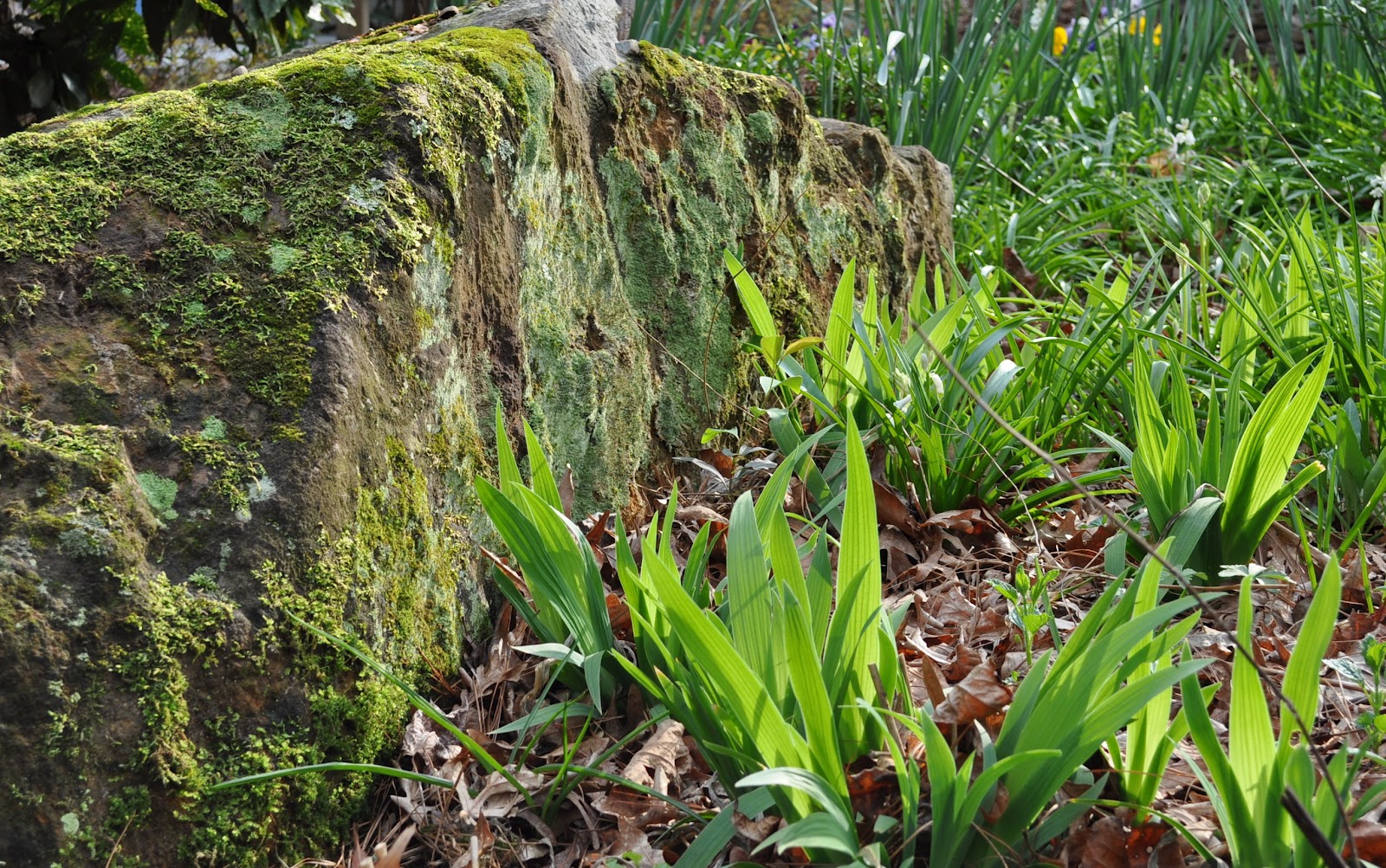
The emerging foliage of Japanese roof iris catches the fading sunlight near the moss-covered boulder. 


Below is one of the many hellebores that grew from seed. It has some pure white flowers amid the more typical pinkish white blooms.


Monday, March 5, 2012

Spring Ephemerals

Spring has arrived along the Piedmont creeks. 
No, you can't tell from the photo below.


But look closely at the ground as you walk. Trout lilies are beginning to bloom. 


I never heard of trout lilies until five or six years ago, when I began volunteering at the North Carolina Botanical Garden. The woman who coordinated our small crew of volunteers was crazy about spring ephemerals. The tinier the flower, the more she liked it. The trout lily flower is not quite as big as in the close-up photo below.


The speckled leaves emerge from the leaf litter in the thousands on slopes along the creeks. They're enchanting. Tiny, subtle, hard to photograph, then gone in a few weeks, leaves and all. 


Spring ephemerals don't have time to grow big blooms. They thrive in the short window between the end of winter and the emergence of leaves, which soon block the light to the forest floor. The sharp growing tip of trout lily, below, punctures a leaf. I can almost see it growing.


Here is what a trout lily looks like from above, growing at the base of a tree among wild ginger. 


Spring ephemerals remind me of fairies. I become a child again, crouching in the leaves to enter their world. Here trout lilies grow among spring beauties, one of the tiniest of tiny flowers.


Spring beauties are about the size they appear in the photo below. They have charming delicate pink stamens. 


Hepatica is hard to find, but well worth looking for. The lavender flowers emerge before the three-lobed leaves. 


Below is a windflower. 


I will join Beth at Plant Postings' meme on Lessons Learned and Donna at Gardens Eye View's meme on Seasonal Celebrations. These little flowers are a celebration. They mark the beginning of spring. 

Winter lessons learned:

1. Do not allow yourself to become so distracted by work and house (even if you have good reasons!) that you don't spend time in the garden and nature.

2. Take more walks in the woods, especially in early spring.

3. Look for the beauty in small signs of life.

4. You can grow seeds indoors under a desk lamp with a compact fluorescent bulb (no need for fancy equipment!)

5. It's a pleasure to see daffodils emerge where you didn't even remember you planted them.


Sunday, February 19, 2012

Duke Gardens in February

The first freezing precipitation of this winter is pelting the house. Yesterday, on a cloudy but warm  afternoon, I visited Duke Gardens to see what was in bloom. A few buds were starting to pop on the tulip magnolias. They are very susceptible to frost, so these adventurous buds may not survive the storm.


Fortunately, most of the buds are still neatly enclosed in their furry coats.


Duke Gardens is conscientious about labeling plants, but they neglected to tag the flowering fruit tree below. Japanese apricot? Japanese cherry? I lean toward apricot because it seems far too early for cherry blooms. 


I don't want to give a false impression that spring is here in central N.C. Here is the view from the garden's famous terraces. Note the unlabeled flowering fruit tree in the top left. 


Paperbush was in bloom in several spots in the garden, including in large pots. The flowers are fragrant. I'll add that to the growing list of plants I'd like in my next garden. 


This is one of the most natural-looking water features I've ever seen.


It seems early for hyacinths, but here they are.


An Algerian iris. These small irises are charming, I think. 


A path lined with hellebores (aka Lenten rose). 


A bed of winter jasmine grows alongside the path next to the pond.


Hope you enjoyed the short tour!

Sunday, February 12, 2012

Of Pine Straw and Hellebores

Gardeners do strange things. Every year I clear leaves from the hardwood trees that shade my yard, then drive several miles to purchase pine tree refuse from a nursery and spread it on the ground. I get satisfaction from this ritual. It instantly transforms the pathways into a uniform reddish brown and sets them apart from  the garden beds, which this time of year are full of decaying leaves and a few early daffodils.


Still, the ritual seems a bit absurd. I am sure that at some future time, people will be amazed at the stupidity of Southerners who spread highly flammable pine straw all over their yards and around their buildings. But the house is going on the market Friday, so this year is not the year to disdain norms of appropriate appearance.

Since I am choosing not to rebel against the realtor who has filled my bathrooms with white towels we can't touch and banished most of the lamps to the shed, I will speak out against the flower breeders who have corrupted one of my favorite flowers.  Hellebores, or Lenten rose, are the joy of my garden in late winter.


Hellebores were born to face down, like bells. They evoke modesty and mystery, with their soft pinkish-purplish white petals.


But our culture doesn't value reserve. People who are loud and outspoken are more entertaining on TV. We like our flowers obvious, too. (Have you noticed the trend toward extremely large blooms on ordinary annuals?) So nurseries are now filled with freakish hellebores with flowers that open upwards.

Hellebores don't look good with their stamens showing - they're unusually plain. So I have none of these expensive freaks. All of my hellebores are descended from one parent. Here is mama hellebore.


I love my hellebores because they're really not mine. They grew from seeds I didn't sow and plants I didn't do anything to care for. Here's how to grow hellebores:

1) Wait until they sprout under the parent plant.
2) Thin the seedlings.
3) In a year or so, transplant them into bare spots in the garden.
4) Ignore them for years.


Hellebores take about four years to bloom. That's another thing I appreciate about hellebores - they refuse to accommodate themselves to our need for instant gratification. Appreciate hidden beauty, they say. Marvel at nature's fecundity. Slow down. Wait for transformation. Live on nature's time, not human time.


Saturday, February 4, 2012

Carolina Wrens Do the Craziest Things

I was settling in on a dark and drizzly afternoon to watch the North Carolina - Maryland basketball game when a movement outside the window caught my eye. A Carolina wren hopped up from the back of a rocking chair on the porch and took shelter on top of the weight of this wind chime. It's still there, half an hour and several slightly blurred photos later. 


Carolina wrens always make me smile. They're the loudest, most curious, cheerful and fearless of small birds. Any open door or new object in the yard must be investigated. One briefly flew into the house the other day when we had the door open. Do you see the little beak peeking down? Words cannot express the pleasure this little bird gave me on a day of too many tasks and errands.